Sunday, February 24, 2013

Guess Who is Coming to Dinner?

Swift identifies the problem in his society as being inhumane to the less fortunate. He begins by describing and agreeing with society on how beggars and their numerous children are a drain to society. He comes up with a proposal, a solution to societies problem. His solution is barbaric and purposely meant to shock his audience. Swift, hopes that by logically linking the common feelings towards the poor with his barbaric proposal, he will shock the audience into realizing that their feelings towards the poor are equally as barbaric as his proposal.

I think his suggestion is serious. He feels that the people of his country are treating the poor like they are less than humane. if they are less than human, then they are animals and he goes into detail describing the poor as animals being prepared as food. He has to treat the subject seriously in order to shock the audience into seen his point.

His solution is so illogical that it is absurd. First, he describes In good detail the situation of the less fortunate, obviously appealing to the sympathies of the audience. Finally, he then transitions into a sarcastic proposal in the attention to make people feel guilty for their lack of compassion.


http://english.edusites.co.uk/images/uploads/A-Modest-Proposal-495w.jpg

Sunday, February 17, 2013

Survivor Cheese


       First, I was captivated by the music in the commercial. It is one of the reasons I did not skip this advertisement to keep searching. Second, I wondered what was going to happen to the mouse while he was nibbling on the cheese. It happened, he was strapped and squeezed by the mousetrap. Finally, the  mouse overcome the trap. Overall, the combination of the music, imagery and the comedy made this commercial enjoyable, even if I was unclear as to how it had anything to do with the selling of cheese.
       It wasn’t until applying the rhetorical triangle model to the commercial that I began to understand the scheme. The mouse is the ethos, or cheese expert. After all the Western media has always painted the mice as cheese cynosures. His willingness to risk death is a testament to the tastiness of the cheese. The music in this case is the pathos. Each song gave credence, it underscored all of the thinks that were happening in the commercial, making the events more believable and sympathetic. I really felt bad for the mouse when the song by the Doors, THE END began playing. As soon as the EYE OF THE TIGER by Survivor started I just knew everything would be alright. The logos is in this case is anti-logic, we know that eating cheese does not make you stronger. The logic in the commercial states that a mouse , an expert on cheese as one would say, risked death by eating the cheese and because he ate the cheese he had the strength to overcame the mouse trap. The mouse’s strength is a metaphor for the strength of the taste of the cheese.
      I found that I am susceptible to pathos, the music was what attracted me to the commercial. I think the commercial was successful. I do want to go out and buy this particular type of cheese. I know it won’t make me strong, but I like strong taste in cheese.

Sunday, February 10, 2013

Barletby; is everyone's ID


Barletby is everyman’s ID
Barletby and the other scriveners in the narrator’s office do not exist. Instead they are a representations of the narrator’s ID, Superego and Ego defense mechanisms. The narrator attempts to use his Ego defense mechanisms, Turkey and Nippers, to balance his ID, Barletby, in order to become a more efficient and industrious worker.
The narrator describes Nippers and Turkey, as having different work ethics. Turkey being a good worker early in the day but a drunk in afternoon (Melville par.6), and Nippers was a good worker in the afternoon and was very irritable and difficult to work with in the morning (Melville par. 11). The Fact that they were able to work well at opposite times insured that things progressed all day, but they could not work alone (Melville par.16).
Prior to Barletby’s manifestation, Turkey was suppressing the narrators’ ID during the early part of the day. By the afternoon, the narrator’s ID would have over come Turkey, hence the manifestation of Nippers. Nipper, as an Ego defense mechanisms, would then keep in check the narrator’s ID for the rest of the day.
Upon reception of the master’s office, the narrator’s work load increased (Melville,par.15). I believe this to be the catalyst for the narrators’ continued break with reality, in the creation of Barletby. At first the creation of Barletby proved successful. The first three days of his employment he worked non-stop day and night completing an “extra ordinary quantity of writing” (Malville, par18).
Barletby, as a manifestation, was the narrator’s last ego defense mechanism. . “I would prefer not to” (Melville, Par.21), becomes Barletby’s motto and the tool that the ID uses to take control of the narrator. His failure to suppress the narrator’s ID, lead to a series of events, concluding with Barletby transformation from Ego defense mechanism to an avatar of the ID.
“All who know me consider me an eminently safe man” (Melville par 3). “had no hesitation in pronouncing my first grand point to be prudence; my next, method” (Melville par 3). These two quotes lead me to believe that the narrator is the embodiment of the Ego making him the opposite of Barletby. In the narrator’s attempt to gain control of Barletby, the narrator is actually trying to gain control of his own ID. This tug of war continues for sometime. After repeated attempts by the narrator to get Barletby to become productive again, he concludes that it will be best to move locations leaving Barletby behind (Malville par.175). This ends the responsibility the narrator feels towards Barletby.
The landlord of the building the narrator used to conduct business out off, then comes to him asking for help in removing Barletby from the old premises (Melville par.189) This to me is a manifestation of the Superego using the conscience of the narrator to reconcile the ID and the Ego (Barletby and the narrator), brining them together again. The narrator’s failure to convince Barletby to be productive or to leave the premises eventually leads to Barletby’s arrest and relocation to the Tombs. The continued failure of the Superego in reconciling the Ego and the ID, leads to more and more obvious and desperate attempts. The evidence is presented in the text when the narrator feels guilt and is drawn to the Tombs to visit Barletby leading to the final show down.
The final shown down between of the ID and the Ego takes place between Barletby and the narrator in the Tombs. The Tombs are now a metaphor for another defensive mechanism of the Ego to control the ID. In the Tombs Barletby confronts the narrator, “ I know you and I want nothing to say to you” (Melville par. 220), being said by the ID towards to Ego, shows evidence of the surrender of the ID. The narrator argues that Barletby himself is to blame for his imprisonment(Melville par.221) .
Barletby maintains his it like qualities by having no rationalization for the things that have happened to him. The narrator shows that he is beginning the reconciliation process by again assuming responsibility for Barletby’s nutritional wellbeing. The narrator does this by paying out of pocket to the grub man for better quality food for Barletby (Melville par. 227).
The story ends with the death of Barletby from the lack of eating (Melville par.250). The way he died tells us that the ID was in full control stubbornly not eating because he preferred not to. Barletby’s death also signified the union of the ID with the Ego. The ID being in perfect balance with the Ego within the Superego makes it unnecessary for the ID to exist separately from the narrator.
After writing this essay I have found better understanding of Sigmund Freud’s ideas of the ID, Ego, Superego and how they work together. After carefully describing the evidence, I found that non of the scriveners in the narrator’s office ever existed. I believe Barletby was a manifestation of the defense mechanism of the Ego and transformed into the avatar of the ID. I also believe that Turkey and Nipper’s were also manifestations of the defense mechanisms of the Ego. Had they not failed, or the increased work load that came with the master’s office had not been a catalyst for a further mental break down, Barletby would have never been created. Furthermore, the death of Barletby to me signified the narrator’s healing process and showed the reunification of the ID and the Ego. The narrator did in fact succeeded in mastering his ID and became a more efficient and industrious worker.

Sunday, February 3, 2013

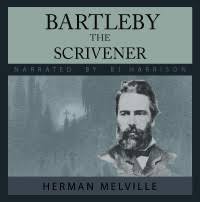
Barletby, the Scrivener

                                           Barletby, the Scrivener: A Story of Wall-street


“Nothing so aggravates an earnest person as a passive resistance. If the individual so resisted be of a not inhumane temper, and the resisting one perfectly harmless in his passivity; then, in the better moods of the former, he will endeavor charitably to construe to his imagination what proves impossible to be solved by his judgment”. (Malville, 7,par 53)Passive resistance only works if people are earnest, this worked with Barletby’s Employer as he tried to help and understand him. However, it failed with the person that took over the building, office, ultimately ending with Barletby’s death in jail. The author is saying that most people are good at heart. When being presented with a challenge people find it difficult to give up, they would rather find creative solutions. I think that is what the author was trying to illustrate when he described the lengths and creativity that Barletby’s Employer was willing to go thru to reconcile his situation.
This must have been what Jesus Christ and Gandhi, were thinking when they began their movements that revolved around passive resistance. Not everyone agreed with their philosophies and many were angered by them as is evident by the assassination of them both..
Gandhi’s movement involved passive aggressive techniques that included non violence and hunger strikes, ultimately giving his life for his cause to a Hindu fanatic. Barletby, exemplifies this not aggressive non violent approached during the time when the constable was escorting him to the tombs and he offered no resistance (par 215) and by his refusal to eat after he is visited by his Employer in the attempt to show his displeasure for his current situation.
The text is rampant with parallels one could draw between Bartlbey and Jesus. “I sat awhile in perfect silence, rallying my stunned faculties. Immediately it occurred to me that my ears had deceived me,” (malville, 5, par 22.)
The employer was stunned by Barletby’s quite refusal, an affront to his authority, moved the employer so much that he decided not to take action towards Barletby in that moment. It was the lack of uneasiness, anger, inpatients or impertinence (par 25). This quote first reminded me of the similarities between Christ and Barletby, that is the way Jesus Christ responded to criticisms from the Pharisees. The second instance was when the mob of people from the Employer’s old building were attempting to have Barletby arrested (par215). Barletby, was calm even in the face of jail and his only friend denied knowing him or caring about him or having any responsibility to him (par190), just as Jesus was arrested and Peter denied him three times.
When the Employer washed his hands of Barletby and rationalizes that he had done all he could it was tantamount to Pilot’s hands being washed of blame for the death of Jesus. The final similarity lies in the ability of both men to have changed the lives of the people who knew them forever, no one who reads this can ever look at the less fortunate the same way, it is the ultimate indictment of the apathy we see in the face of the Me, Me, Me, country we live in where people care more about how much they pay in taxes without regard to the welfare of the needy. It reminds me of the beatitudes, were Jesus said, blessed are the poor, blessed are the meek for the kingdom shall be theirs.
 
 
 https://encrypted-tbn1.gstatic.com/images?q=tbn:ANd9GcS5krX7fw5d1RDiMLwRyGMErLqVtTGFLSWT4qRLzCMLCRC6-ntngQ

Herman Malville (1819-1891)